
Montclair, New Jersey, September 3, 2026—The Montclair Art Museum presents Nadia Myre: Analog/ues, the first major exhibition in the U.S. celebrating the multidisciplinary work of Canadian Indigenous artist Nadia Myre (Algonquin, Kitigan Zibi Anishinabeg First Nation, b. 1974). Featuring more than 40 of Myre's experimental works—including ceramic beadwork, digital prints, videos, mixed media, and textiles—the exhibition invites cross-cultural dialogues about Native and settler histories of North America. The presentation emphasizes her recent work and debuts new, large-scale pieces. On view from September 19, 2026, through January 17, 2027, the exhibition is organized by the Montclair Art Museum, curated by Laura J. Allen, Curator of Native American Art and Repatriation Coordinator, and is accompanied by an exhibition catalogue.
Rooted in curiosity and discovery, Myre’s practice reinterprets records of history such as wampum belts, national anthems, maps, and treaties. For this U.S. exhibition and to mark the nation’s 250th anniversary, MAM is presenting pieces that rework two foundational American symbols, the American flag and the Declaration of Independence, to investigate nationhood and sovereignty. Myre’s work often considers, obscures, and transforms historical texts and narratives, prompting viewers to examine them through a new lens.
“Nadia Myre’s work is revelatory because she doesn’t provide answers—she invites us to question who we are and how we relate to one another,” says Allen. “Her process turns over the meanings of historical archives, decodes and re-encodes their hidden contexts, and translates them into bold new forms that build pathways to understanding.”
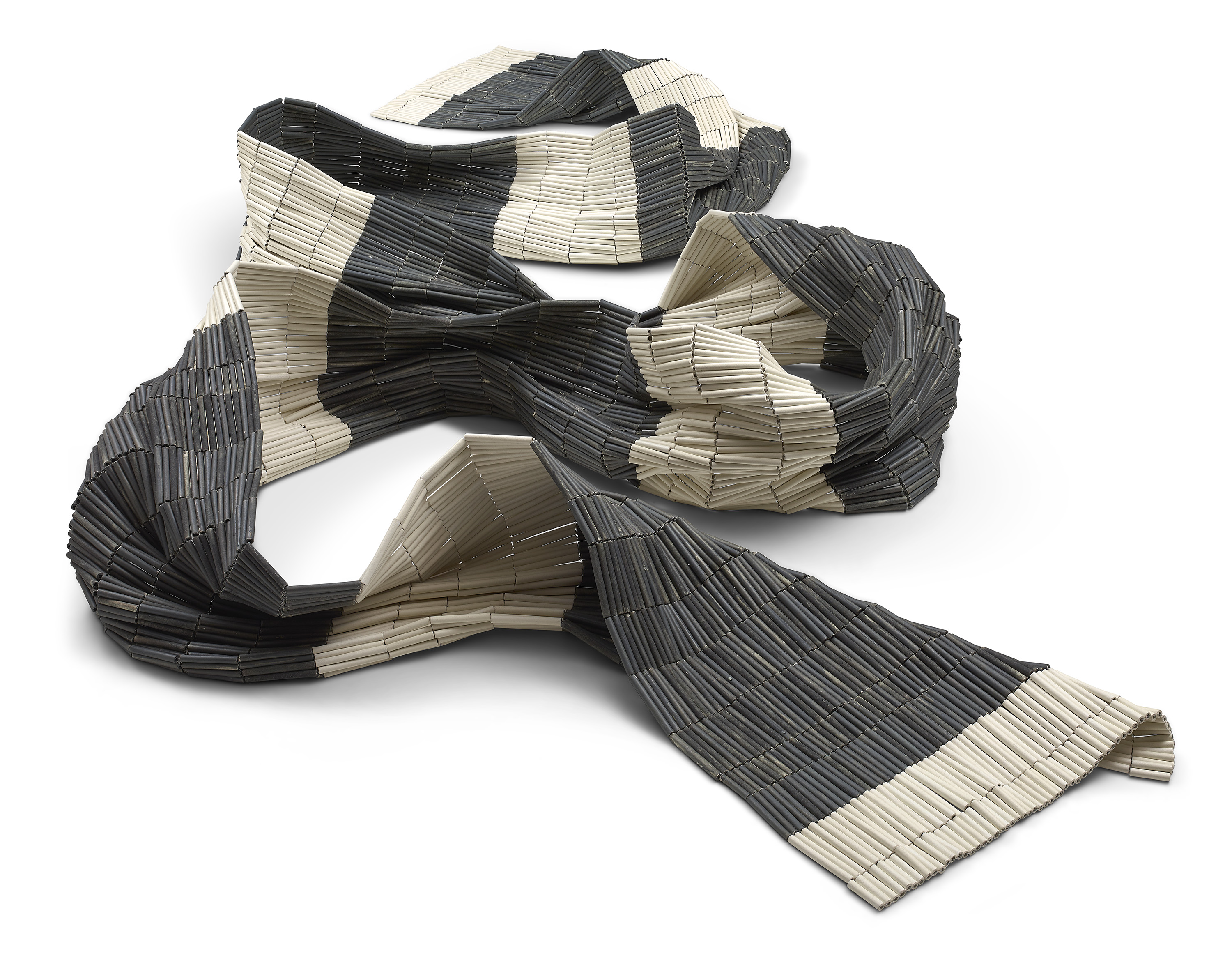
The exhibition features extensive examples of Myre’s ceramic beadwork; an artistic direction sparked entirely by chance. While exploring the banks of London's Thames River with her son, Myre encountered the broken clay stems of colonial-era smoking pipes. The discarded pieces of history not only link European settlers to Indigenous tobacco use but also reminded her of oversized beads. For Myre, the fragments spoke of power dynamics and interconnection, and she began developing her own “pipe beads” in ceramic. Handmade and awash in color, her beadwork has shifted from wampum-like compositions in glass seed beads to abstract tapestries, three-dimensional baskets, and netted, woven, and draped sculptures.
Myre’s immense new wall work Axiomatic Choreography (2026) continues her long-standing interrogation of national documents through an Indigenous perspective. For the piece, Myre wrote a poem inspired by the U.S. Declaration of Independence and translated it as enlarged clay tubes curved by hand into Gregg shorthand, a looping stenographic script. By rendering the iconic words into a language that is largely unreadable, she turns this foundational document into a coded, material sculpture to address the limitations of the text and text-based records. Because decoding it is a challenge, the work directly confronts the viewer.
The companion works Drift (2026) and Unmoored (2026) are horizontally mounted ceramic tapestries that recast the American flag. The monumental piece is presented in two parts. The first section renders the red and white stripes in fired and painted ceramic beads as an unfurling landscape. The second section displays blue beads representing the stars in the flag.
Myre also found inspiration from nineteenth-century non-Native-made wampum found in the Museum’s permanent collection. The fabricated beads of Caribbean conch shell were created in a New Jersey factory and served as trade goods. Myre’s work Rigged (2026) is a bold departure from her loom-woven styles, with dynamic, cascading ropes of studio-crafted beads in rich, variegated shades of purple. By highlighting purple, historically the most valuable color of wampum beads, Myre comments on trade, worth, and cultural exchange.
The exhibition title, Nadia Myre: Analog/ues, offers a clever play on words that provides insight into the materiality of her work, her practice, and the Montclair Art Museum’s historical collection. On one level, Myre’s “analog” approach honors handmade traditions like beadwork as a tactile way of recording information and agreements long before the digital age. The title also addresses the idea of how museum objects, historical documents, and Indigenous narratives relate to one another. By playing on the subtle spelling shift between the American “analog” and the Canadian and British “analogue,” the title's slash invites viewers to explore double meanings across materials, language, and borders.
With these multiple meanings in mind, the full depth of Nadia Myre: Analog/ues comes into sharp focus. Myre’s slumping vessels and net-like ceramic forms seem to bend under their own weight and become analogues to customary baskets and other Native forms. There are numerous historical analogues on view as well from the Museum’s collection, such as a Lakota breastplate made of elongated bone “hair pipe” beads and an Algonquian bandolier bag that mirror Myre’s beading techniques.
Anchoring the educational programming for Nadia Myre: Analog/ues is the Annual Julia Norton Babson Lecture on November 22, featuring artist Nadia Myre and historian Alan Ojiig Corbiere (M'Chigeeng First Nation) for an in-depth conversation around themes of wampum beadwork, land, and nationhood. In addition to this flagship event, the Museum offers accessible, multi-generational learning tied to the exhibition from September through January. Families with children ages 5 to 12 can dive into hands-on Sunday Studio Art workshops offered across multiple afternoons, while adults 55 and up can explore the work in dedicated Art in the Afternoon sessions on select Thursdays ($7 for members, $10 for nonmembers). With standard Museum admission, free guided public tours run on select Sunday afternoons at 2 p.m., providing visitors with a deeper connection to the exhibition. Visit montclairartmuseum.org for the complete schedule.
The Montclair Art Museum is publishing a 148-page catalogue for the exhibition with contributions by Indigenous scholars and designers specializing in contemporary art, transnational Native histories, and Anishinaabe language.
Contributors include Candice Hopkins (Carcross/Tagish First Nation), Executive Director/Chief Curator, Forge Project; David Garneau (Métis Nation of Saskatchewan), Professor of Visual Arts, University of Regina; Alan Ojiig Corbiere (M'Chigeeng First Nation), Assistant Professor/Canada Research Chair in Indigenous History of North America, York University; and Taylor Rose Payer (Turtle Mountain Band of Chippewa), PhD Candidate, Art History, University of Minnesota and Fellow, School for Advanced Research.
The introduction and text for the works in the catalogue are written by exhibition curator Laura J. Allen.
Catalogue and exhibition graphic design is by the BIPOC-led design firm Polymode.
Nadia Myre: Analog/ues is made possible with major support from the Henry Luce Foundation, The Andy Warhol Foundation for the Visual Arts, and the Consulate General of Canada in New York.
All MAM programs are made possible in part by funds from the New Jersey State Council on the Arts, a Partner Agency of the National Endowment for the Arts, and Museum members.
Nadia Myre (Algonquin, Kitigan Zibi Anishinabeg First Nation, b. 1974) is a visual artist based in Montreal, Canada. She is a graduate of Camosun College, Emily Carr University of Art and Design, and Concordia University, where she currently serves as the Canada Research Chair in Indigenous Arts Practice and directs her studio, Kìnawind Lab. In her acclaimed career spanning three decades, Myre's work has been exhibited extensively in North America, Europe, and beyond, and has earned her numerous accolades, including the Eiteljorg Fellowship (2003), Sobey Art Award (2014), Ordre des arts et des lettres du Québec (2019), and the Prix Paul-Émile-Borduas (2025).
Since her early pieces, such as Indian Act (2002) and The Scar Project (2005–2013), Myre has explored the politics of belonging, placing personal and collective narratives within broader frameworks of Indigenous resistance, resilience, and relationality. Myre’s last solo exhibition in the U.S. was Skin Tissue in 2010 at the National Museum of the American Indian, New York, NY.
The Montclair Art Museum (MAM) is Northern New Jersey’s premier public arts institution, a civic anchor, and a vibrant cultural hub presenting dynamic exhibitions, public programs, studio art classes, group tours, and community partnerships that spark creativity, collaboration, and conversation. MAM was established in 1914 with significant collections of historical and contemporary American and Native American art. Today, the Museum maintains its commitment to emerging, underrepresented, and regional artists with a renowned collection of more than 14,000 works. The MAM School of Art welcomes all ages and abilities year-round for award-winning educational programming and accessibility initiatives, including classes, workshops, and camps. MAM is a gathering place and community catalyst that invites dialogue, empowers all voices, embraces creative expression, and fosters belonging, connection, and awe.
Instagram: @mammontclair
Hashtag: #MAMNadiaMyreAnalogues
YouTube: @MontclairArtMuseum/In the Studio with Nadia Myre